Oris is now in public beta
A lot of my meetings produce decisions I half-remember by the next morning. I’ve tried the recording-bot approach: a third-party account joins the call, audio gets routed through servers I don’t control, and a transcript comes back that technically lives on someone else’s platform. For anything sensitive, that tradeoff matters. Even setting that aside, I don’t like not knowing where my meeting audio lives.
Oris (previously called lognote) is the app I built to fix this. Public beta is open today at orisnotes.com.
What it is
Oris is a native Mac app for Apple Silicon. Hit record before your call, run the meeting, stop when you’re done. No bot joins the call, no calendar integration required. It captures both sides of the conversation directly off your Mac’s audio system.
Transcription runs on-device via WhisperKit. Your meeting audio stays on your machine by default. When the recording finishes, Oris writes the full transcript as Markdown into your Obsidian vault or any .md folder you point it at. With a summarization model configured, it also adds a summary and any relevant sections the transcript actually supports, like decisions or action items. Notes land in a folder you own; there’s no platform to log back into.
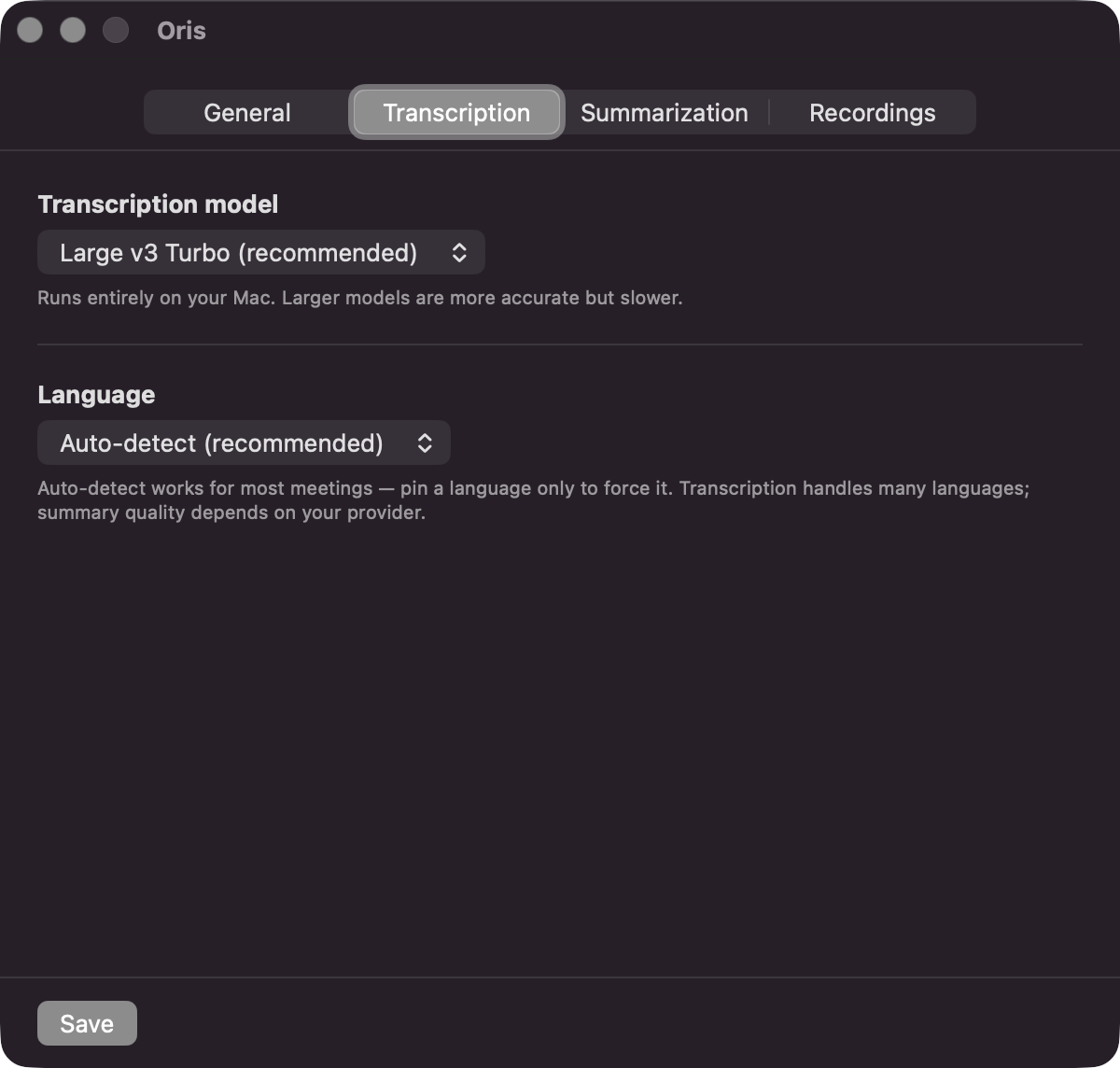
Summarization is bring-your-own-key: you connect a cloud model you already use, or a local model you run yourself. The audio path is what Oris controls. The summarization model is your choice.
Why the audio path matters
Most meeting-recording tools treat your audio as upstream input to their service. Running transcription at scale is easier centrally, and that architecture makes sense from their side. From your side, it means every meeting you record is a voice file of your colleagues, customers, or investors, sitting in infrastructure you don’t operate, under retention policies you had no say in.
For casual standups, that’s probably not a concern. For the conversations that actually matter — strategy discussions, candidate debriefs, anything commercially or legally sensitive — the standard response has been to skip recording entirely. You end up with no durable record of exactly the conversations worth capturing.
Oris’s transcription step doesn’t touch the network. Audio never leaves your machine as part of the core recording flow. If you choose to summarize through a cloud model, that’s a deliberate decision you make with your own API key and your own account relationship. The distinction between “I sent text to a cloud API I chose” and “a service ingested my audio by default” matters the moment you have colleagues with data expectations, or guests on your calls who might reasonably care where the recording goes.
What lands in your vault
After each session, a Markdown note lands in your vault. The full transcript is always there. If you have a summarization model connected and the request succeeds, Oris also adds a summary plus any relevant structured sections, such as decisions or action items. Plain text, in a folder you own. No export step, no proprietary format to migrate away from later.
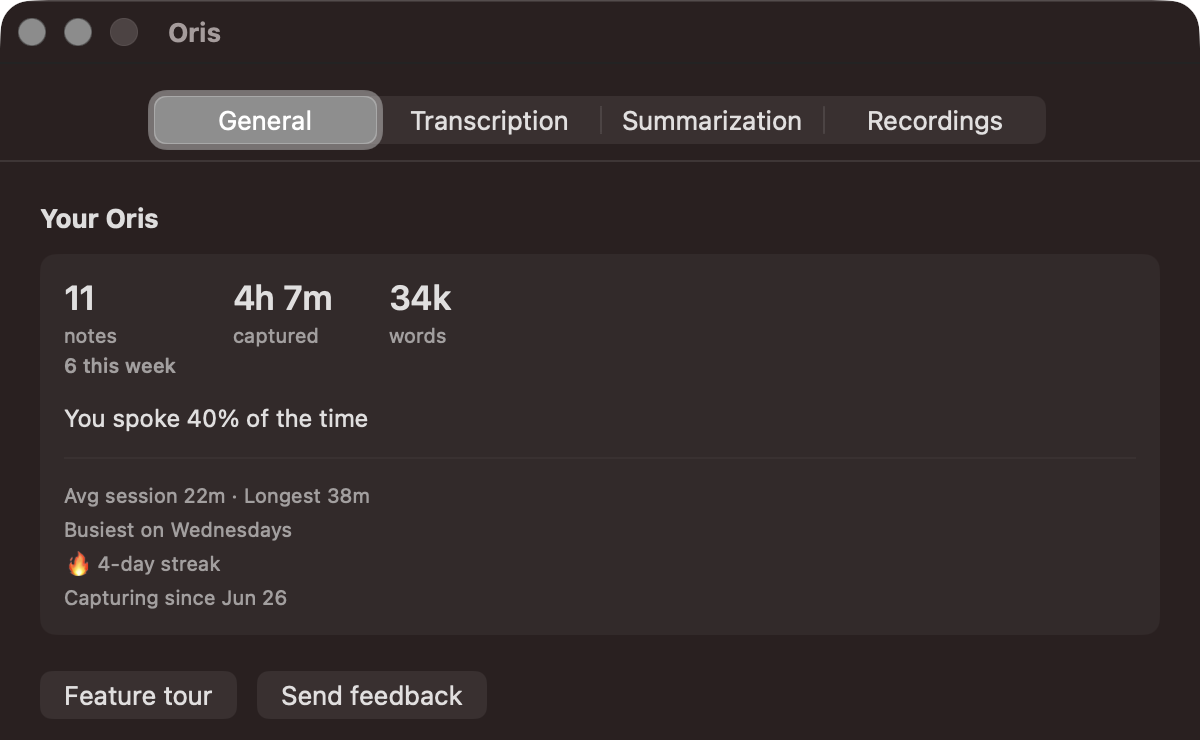
There’s also a talk-ratio card: an overall stat for how much you’ve spoken versus listened, aggregated across your recorded sessions. Meeting behavior is hard to notice in real time; a few weeks of data and patterns start showing up in your own habits.
Public beta
The beta is live at orisnotes.com. Beta users get automatic updates as new versions ship.
Apple Silicon only for now. On-device transcription is what makes the whole thing work, and that’s an Apple Silicon story for the moment.